
Have you spent weeks crafting the perfect blog posts, optimized your headers, used your targeted keywords naturally, and even built some backlinks? But upon checking Google, your page is nowhere near the top or even the first three pages.
And the cherry on top is that your competitors, some even with weaker content and visuals, are consistently outranking you.
Disappointing… right! We all have been there.
Sadly, this happens more often than you think. From small startups to well-established corporations, many businesses miss out on crucial SEO practices.
The result? They remain buried under the competition, despite putting in enough hard work.
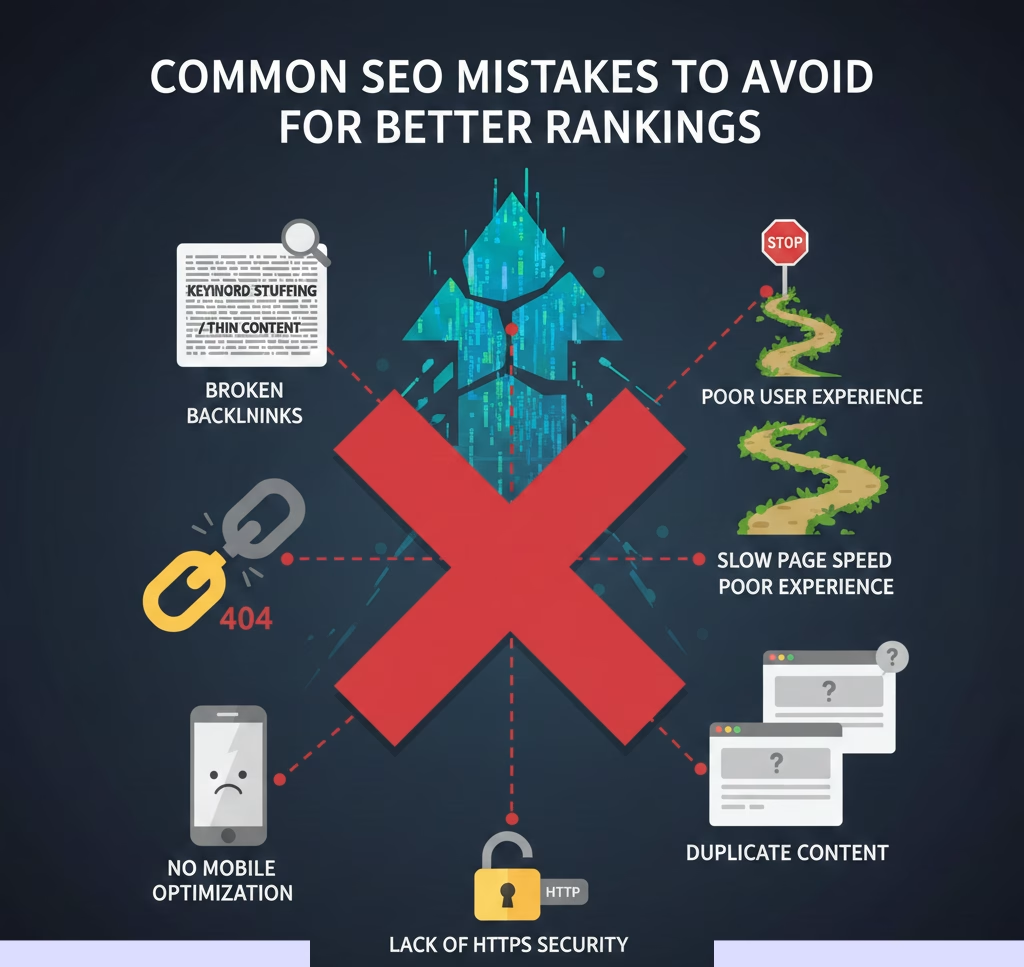
That’s why we’ve pulled together the most common SEO mistakes businesses make – along with practical ways to fix them.
And because SEO today goes beyond code and keywords, we’ll also talk about holistic SEO: a balanced approach that covers content, technical setup, and, most importantly, user experience (UX).
Before you assume your SEO strategy is solid, read through this list – you might discover exactly why you’re not ranking where you deserve to be.
1.Neglecting the fact that slow sites lose clicks (and rankings)

The very first impression is your site’s speed. A faster site becomes visitors’ and Google’s favorite, after which it moves on to checking other factors to meet its criteria. Google ranks good page experiences.
Optimizing your images remains one of the most crucial ranking factors that many people overlook. Many websites display relatively large images, which naturally take longer to load. This slows down the speed of your web pages, causing your visitors to turn away instantly.
Image resizing empowers your site by improving its loading time. Optimize your images to reduce their size. Working with WordPress, you can easily achieve this milestone by installing a plugin that does it well for your site.
You should also continue to look for the active plugins. Working with all of them is not necessary all the time. Instead, you should use one that combines all those features. Less is more, so working with fewer ‘activated’ plugins will speed up the loading of the WordPress installation process.
Websites that load fast rank better!
Pro Tip: You can check your page speed using Google’s own tool, Google PageSpeed Insights. Using this tool, you can gain an overview of the key aspects that need improvement on your page.
2. Taking help from wrong keywords

Ranking in Google requires using the right keywords for each page on your site. As marketers, we frequently face the issue that most site owners use generic keywords while trying to optimize their sites.
Understand it with this example: a small business wants to rank for “rental apartments”; they are taking a broader aspect for coverage, which will make their task more difficult. They should use words that are more specific to help you at the first stage of your struggle.
Or else, the bigger competition, which not only pre-exists online but also has built high authority in their niche over the years. Instead, add your company location to the keyword list so Google can focus on your area of offerings to the locals.
There’s much more you can do to appear high when your specific audience searches for your offerings. This technique focuses on long-tail keywords or phrases that your competition might not be using currently.
Using longer and more specific keywords increases your chances of ranking higher and being found in search results. Although the search volume for these keywords remains lower, you can bypass this by establishing and optimizing many pages on your site (your blog) for different long-tail keywords.
What will happen after that? Your site will gain more visitors for all of these keywords combined. One primary keyword will never be enough to get you there.
Good to know: Despite a low search volume, a long-tail keyword means a more specific search intent, which Google loves and never ignores. It means you might reach fewer people, but you are reaching the right people.
3. Not working hard on enticing people to visit your site

Event planning flat composition of calendar app location messaging signs chat bubbles computer and worker character vector illustration.
Let us also shed some light on something that is frequently not taken into consideration: metadata. Metadata is the striking information that appears on the search engine result pages (SERPs) when a website appears in an online search.
It contains the meta description of your page and its title.
The page title remains a critical ranking factor at Google, so you must ensure it is done correctly on each page. You just need to spend a few minutes making it highly engaging, short, and to the point to make it click-through.
Adding keywords to your site is always a good idea, while you should also keep your title length short. Longer titles are clipped when search results appear.
Note that the meta description itself is not a ranking factor, but it does impact your Click Through Rate (CTR). Optimizing meta descriptions makes it easier for people to see the information they are looking for; it’s a clear signal that it’s there.
A meta description is a direction for people to think that your site will provide an answer to their search query. This way, that page will gain more traffic.
4. Overlooking the power of quality content

Writing with impact is as important as your products or services. Many sites still struggle with writing effective content and achieving the desired results from it.
Every page on your site must have at least 300 decent, meaningful words that are relevant to your niche and create value for your site visitor in one way or another.
Jumping into the digital landscape, you can’t simply imagine that search engines will start taking you as an authority on the topic you came up with, while you have written a few lines about it.
Google needs sufficient copy and information from you to find out what your page has to offer. It will cross-check whether you have provided the complete answer people are looking for and how effectively you are answering it.
If you complete that checklist, you are good to go and rank! Content taken from AI, and using it as is, or thin content tells Google that your page isn’t sharing the best value and isn’t the best result to match the search query.
We don’t say this because Google is our primary audience. Instead, it serves the right content to the audience who’s looking for it. So, prioritizing your audience while writing quality content is key to ranking well in Google.
With writing quality content, we mean writing original content that shows your expertise and is also easy to read to educate and convert your audience into your customers.
Have a look at what original content can do for your site:
- Optimize your site for search engines
- Improves your SEO (search engine rankings)
- Drives engagement
- Becomes your consistent brand voice
- Saves you and your visitors’ time
- Boosts conversion rates for your business
- Helps optimize your existing content
- Establishes thought leadership
- Reduces expenses
- Helps understand your audience
- Remains a reliable mode of constant interaction with your audience, etc.
5. Struggling to keep visitors engaged
Sometimes, your users may leave before they have a chance to explore. Losing them too soon hurts rankings.
Once they land on your site, the next goal is to keep them there. You must find ways to encourage them to stay longer using decent, logical calls-to-action.
These CTAs are buttons that offer an action to your visitor. Some common examples of CTA buttons are as follows:
For Products / Sales
- Buy Now
- Shop Today
- Add to Cart
- Get Yours
- Order Now
- Claim Deal
- Grab It
- Checkout Fast
- Don’t Miss Out
- Limited Stock – Buy
For Sign-Ups / Lead Gen
- Join Now
- Sign Up Free
- Start Today
- Subscribe Free
- Get Started
- Try for Free
- Join the Community
- Yes, I Want it
- Sign Up Free
- Claim Free Trial
- Unlock Access
For Service / Engagement
- Book Now
- Let’s Talk
- Schedule a Demo
- Contact Us
- Start Saving
- Get a Quote
- Try it Today
- Learn More
- Explore Now
- Discover Now
- Boost My Results
Instead of crowding your page with multiple call-to-action buttons, focus on a single main CTA that grabs attention and guides your visitors clearly.
Equally important is your internal linking strategy. By connecting your pages with relevant links, you help both users and search engines understand how your content relates. This not only improves SEO but also encourages visitors to explore more of your site when searching for specific information.
Take the time to build a strong internal linking structure – it’s a simple step that keeps people engaged and browsing longer
6. Not optimizing your site for mobile devices
Another of the most common seo problems is not optimizing sites for mobile phones. Nearly 5.7 billion people around the globe are now using mobile phones on the go to fetch information they need instantly.
This equals 70.5 percent of the world’s total population. Data also shows that smartphones now account for around 7 percent of the mobile handsets being used worldwide.
Google switched to mobile-first indexing a few years ago – means Google now also looks at the mobile version of your site to decide about your rankings. So if your site does not perform well on mobile devices despite being a good version for desktop, this will impact your credibility and positioning negatively.
Seconds is the cutoff time. 53% of mobile users abandon a website if it takes longer than 3 seconds to load.
So, don’t neglect your mobile SEO.
Pro Tip: Google has retired its Mobile-Friendly Test, so the best way to check your site’s mobile responsiveness today is with Lighthouse (via Chrome DevTools or PageSpeed Insights).
Run an audit in mobile mode to see performance, usability, and SEO insights. Then, go hands-on: test your site on real devices and supplement with responsive design tools like BrowserStack, LambdaTest, or Responsively to preview across screen sizes and browsers.
Click every button, CTA, and menu yourself – if navigation feels smooth, layouts hold up, and Core Web Vitals pass, your site is competition-ready.
Remember, a great user experience is the real game-changer for your rankings.
Closing Note on Common SEO Errors
Applying and maintaining the proper SEO techniques is a significant amount of hard work. Covering each part regularly on the go is also challenging. But this is the only savior for our digital presence that helps us get seen online; we must keep a regular check.
One mistake and it hurts your rankings. So, avoid the mistakes in SEO mentioned earlier, including ignoring sitespeed, writing irrelevant or ineffective content (just for the sake of doing it), and not optimizing for the right keywords.
Create quality content that entices web users to visit your site and stay there until they receive the value you tried to share in the first place. The visuals and CTAs on your site, along with relevant internal links, can optimize your website. Also, don’t forget to optimize it for multiple devices.
This can be a holistic approach to get there and make the most of your investment. To learn more about SEO, check out this post on effective ways to improve your site’s SEO.
You can get everything you need to know about the proven techniques to get your website seen on search engines like Google.


